Xiaomeng Chen’s Homepage
Welcome! I am an Assistant Professor in the School of Science and Engineering at The Chinese University of Hong Kong, Shenzhen. I obtained my B.S. degree in Electronic Information Science and Technology from Nanjing University in 2019, and received my Ph.D. degree in Electronic and Computer Engineering from The Hong Kong University of Science and Technology (HKUST) in 2023. From September 2023 to December 2025, I worked as a Postdoctoral Fellow in the Department of Electronic and Computer Engineering at HKUST.
Research Interests
My research focuses on distributed design in decentralized multi-agent systems, where agents make decisions using local information and peer-to-peer communication rather than a central coordinator.
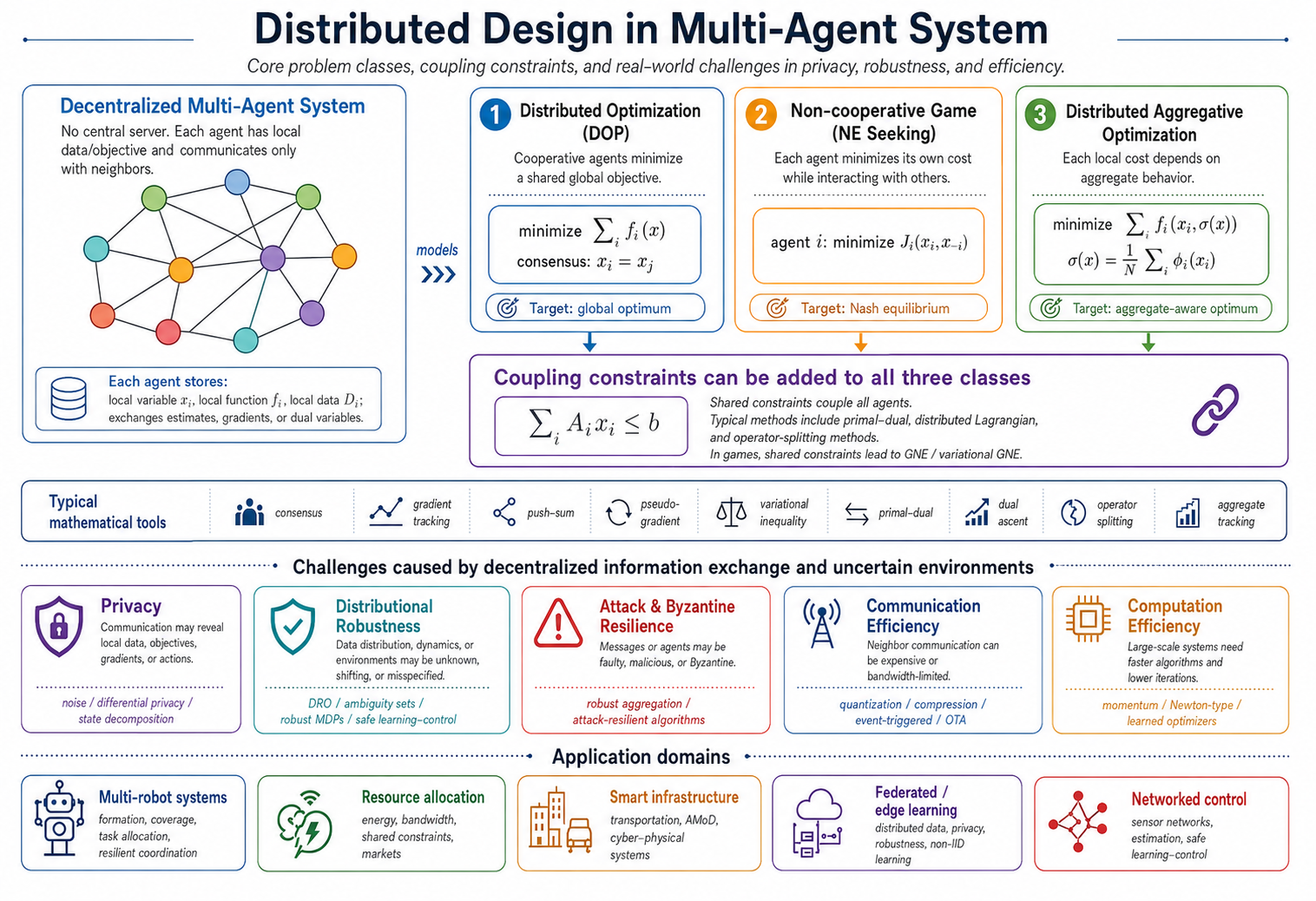
The main problem classes I study are distributed optimization, non-cooperative games, and distributed aggregative optimization. Coupling constraints, such as shared resource or safety limits, can be added to all three classes and often lead to primal-dual, distributed Lagrangian, dual ascent, or operator-splitting algorithms.
Because agents exchange information only through decentralized communication, the algorithm design must also address privacy, distributional robustness, attack and Byzantine resilience, communication efficiency, and computation efficiency. These questions are motivated by applications in multi-robot systems, resource allocation, smart infrastructure, federated and edge learning, and networked control.
See here for our publications.
Openings
We are always looking for highly motivated students, postdoctoral researchers, and research assistants with a strong mathematical background and research interests in distributed optimization and learning, differential privacy, game theory and multi-agent networks. Opportunities for academic exchange and collaboration in Hong Kong, Europe, and Australia may be available for suitable candidates.
Interested candidates are welcome to contact me via email with a brief CV.